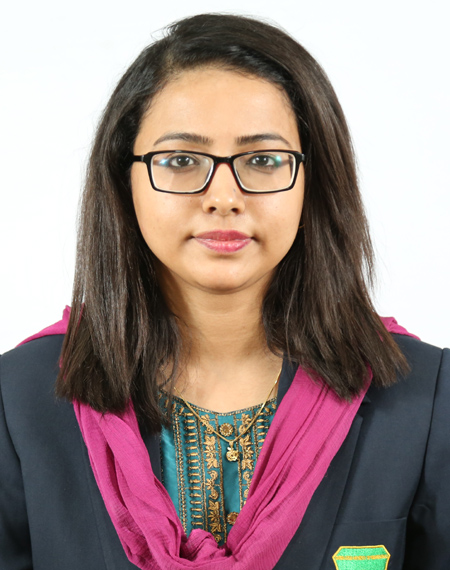
Maliha Tabassum has been instructing department of mass communication and Journalism as an assistant professor at Bangladesh University of Professionals for about five years.
Last Updated:
27 Oct 2026
1. Tabassum, M. & Partha, S. B. (2026). YouTubeThumbnails as Political Frames: Insights from Bangladesh's July Revolution. InH. Rahman & D. I. Manik (Eds.), Critical Media Perspectives on the 2024Bangladesh Uprising (pp. 215-228). Bloomsbury.
doi.org/10.5040/9798216371526.00242. Tabassum, M. (2026). Redefining Heroism: The ChangingPortrayal of Heroes in Bangla Cinema Posters. BCTI Bangladesh Journal,14th Edition.3. Tabassum, M. (Accepted, 2026). AI-Armed Disinformationand Election Security in Bangladesh: A Qualitative Case Study of the Six-MonthPre-Election Period (August 2025-February 2026). Accepted by the competentauthority, Centre for Strategic and Peace Studies (CSPS).4. Tabassum, M., Rakib, M. A. A. & Promi, I. J.(2025).
War on Reels: AComparative Study of the 1971 Liberation War in Films from Bangladesh, India,and Pakistan. BUP Journal, 12(1).5. Tabassum, M., Partha, S. B. & Kundu, P. (2025).Human Rights and Digital Surveillance: A Case Study of Pegasus SnoopingScandal. BUP FSSS Journal, 1(1).6. Khan, M. A. K., Mehjabin, S. S., Tabassum, M., Partha,S. B. & Biswas, A. K. (2025).
Practices andInnovative Approaches in Post-Secondary Media Education during the Covid-19Pandemic in Bangladesh. In Digital Inequalities in MediaEducation in South Asia (pp. 266-281). Routledge.7. Tabassum, M. (2024).
Future of LocalOTT Platforms in Bangladesh: Boon or Bane. Bangladesh Film andTelevision Institute Journal, 13th Edition.8. Tabassum, M., Partha, S. B., Goni, A. & Kundu, P.(2024).
ArtificialIntelligence and Future Newsroom: A Study on Journalists of Bangladesh.Pacific Journalism Review, 29(1). [Q3]9. Islam, M. A., Das, A. & Tabassum, M. (2023).
Factors AffectingTrust in News Media among Young People in Bangladesh. World ofMedia, Issue 3. [Q1]10. Kundu, P. & Tabassum, M. (2023).
Harassed andHushed: Bangladeshi Women Journalists' Experiences of Gender Discrimination andSexual Harassment. Athens Journal of Mass Media &Communications, 9(3). [Q3]11. Mim, M. B. & Tabassum, M. (2021).
A Critical Studyon Female Roles in Television Commercials of Bangladesh. Informasi,51(2), 249-266.12. Haque, M., Tabassum, M. & Maqbul, N. E. (2021).COVID-19 and Political Leadership: Understanding the Corona-time Metaphors ofBangladesh's Political Leaders. Journal of Bangladesh Studies, 23(1),Special Issue on COVID-19, BDI (USA).13. Goni, M. A. & Tabassum, M. (2020).
Tied to the MobilePhone: Exploring the Nature of Nomophobia among the Students of Bangladesh.BUP Journal, 8(1).14. Goni, M. A. & Tabassum, M. (2020).
ArtificialIntelligence (AI) in Journalism: Is Bangladesh Ready for It? A Study onJournalism Students in Bangladesh. Athens Journal of Mass Mediaand Communications, 6(4), 209-228.15. Tabassum, M. & Kundu, P. (2020).
E-leadership in Social Change: A NewParadigm in Bangladesh. Nepalese Journal of Management Scienceand Research, 84-97.16. Tabassum, M. & Al Karim, S. S. (2020).
Fruitful or EmptyTalks: Analyzing Political Talk Shows before the National Election ofBangladesh. International Journal of Social Sciences andHumanities, 4(1).17. Tabassum, M. & Hossain, M. S. (2019).
Oral CommunicationApprehension among Undergraduate Accounting and Journalism Students inBangladesh. IJLLT, 3(1). doi:10.32996/ijllt.2020.3.1.20Citations: 100+ |
ResearchGate |
Google Scholar
Last Updated:
27 Oct 2026
.png)
.png)
.png)
.png)
.png)
.png)